Gold Creek
Located near Snoqualmie Pass in Kittitas County, WA, is in the headwaters of the Yakima River. It flows into Keechelus Reservoir and is home to a genetically distinct population of ESA-listed Bull trout.


Project Details
Date Completed
Ongoing
General Area
Snoqualmie Pass
Funding
$19,777,330.93
Outcomes
- Reduce the extent and duration of dewatering
- Increase habitat quantity
- Add habitat complexity
- Restore 27 acres of forest wetland
Gold Creek Valley has been degraded by decades of gravel mining, road building, and clear-cut logging.

1942: Before significant logging & mining in Gold Creek Valley.

1975: Shows extensive logging and road development. The loss of riparian plants has allowed erosion to unnaturally widen the channel, while the gravel mining pits start pulling groundwater away from Gold Creek.
Project Outcomes By the Numbers
| Miles of in-stream restoration | 2.5 |
|---|---|
| Large wood structures installed | 139 |
| Miles of side channels reconnected | 1 |
| Acres of floodplain reconnected | 245 |
| Native plants planted | 15,283 |
| Cubic yards of fill placed to retore gravel borrow pits | 212,600 |
| Gravel pits fully restored | 1 |

These actions have dramatically impacted streamflow.

The lower 1.5 miles of Gold Creek dewaters from late July to October, a period that overlaps with Bull trout spawning migrations and limits their ability to reach spawning grounds farther upstream.
Juvenile Bull trout rear in Gold Creek, but they too struggle to survive in the dewatering stream.
They become stranded in isolated pools as the stream disconnects


and if they aren’t rescued….


the fish will succumb to predation or desiccation as the pools dry up.


The Gold Creek Bull trout population is in severe decline.
The Gold Creek Valley Restoration Project aims to restore this critical habitat for Gold Creek Bull trout before it’s too late.
KCT and partners are working to restore natural streamflow, increase and enhance instream habitat and habitat complexity, and reconnect floodplains. Strategically placed side channels and engineered log jams, or ELJs, will also reduce velocities and erosion risks for the stream-adjacent communities (circles represent privately-owned parcels).

This large project has been separated into multiple phases.
Phase 0: COMPLETE. KCT and partners worked from 2012 to 2025 to complete:
Surveys, Data Collection, & Analysis


Project Planning, Design, & Permitting


Phase 1: Instream Restoration -COMPLETE! Phase 1 was fully constructed in 2026, restoring instream habitat complexity and riparian areas, reconnecting floodplains and working toward the restoration of groundwater hydrology in Gold Creek Valley. In just one construction season KCT and all our amazing partners accomplished the following:
• 2.5 miles of Gold Creek restored
• 139 Engineered log jams installed
• 1 mile of side channels excavated and reconnected
• 245 acres of floodplain reconnected
• 15,283 native plants installed
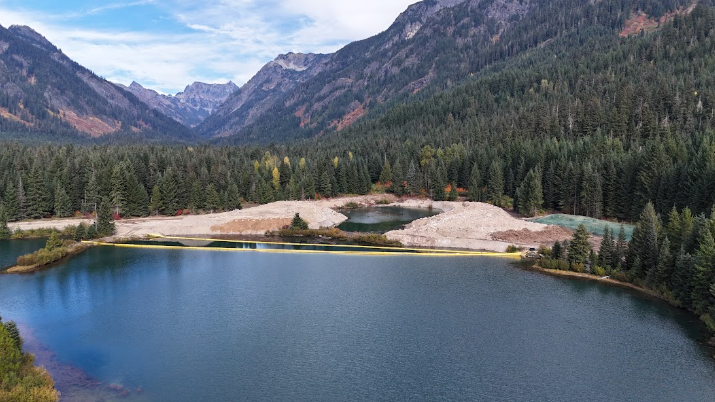
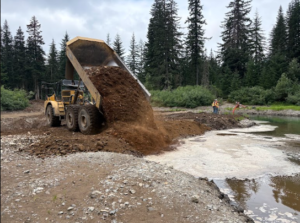
• 6,600 cubic yards of fill material placed to restore the Heli’s Pond gravel pit
• 206,000 cubic yards of fill material placed into the Gold Creek Pond gravel pit

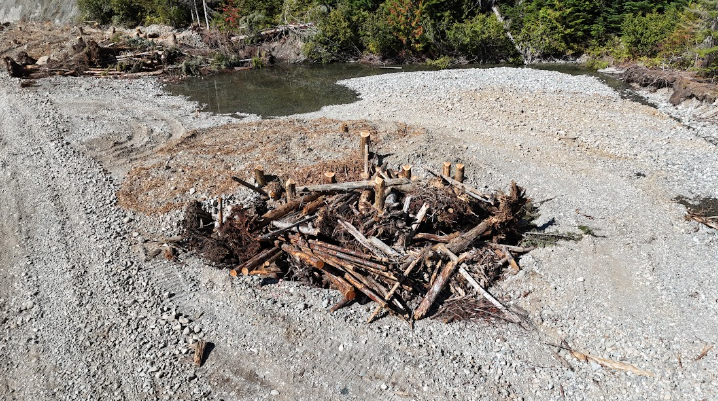
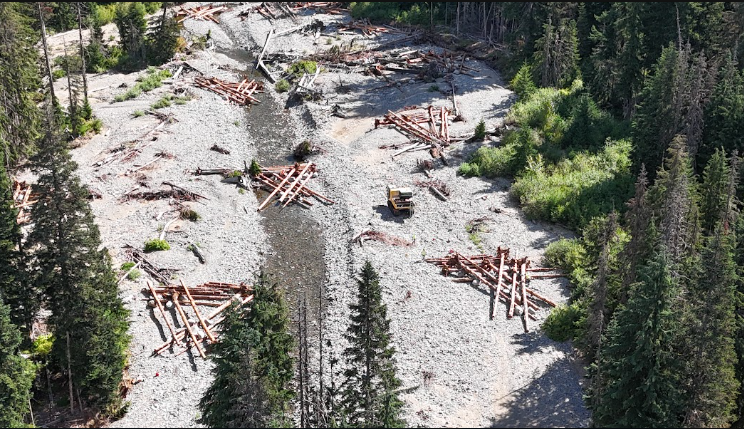
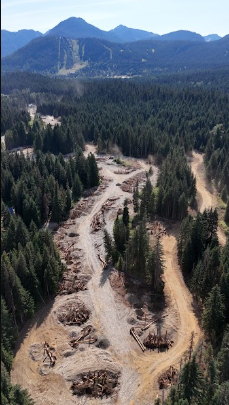
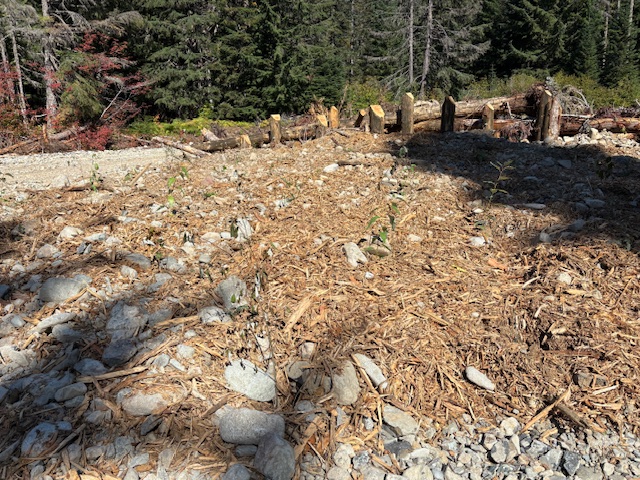
The ELJs will reduce velocities and provide habitat complexity, as well as concentrate flows during low flow periods. The reconnected side channels act like pressure relief valves, reducing velocities and moving flows away from adjacent communities during high flow periods. The planted and reconnected floodplains allow high flows to spread out, further reducing velocities and risk of erosion. Finally, the addition of fill to restore the gravel borrow pits is the first big step in restoring groundwater hydrology in Gold Creek Valley and improving instream flows in Gold Creek.
For more details and pictures of Phase 1 implementation, see our blog post, Gold Creek Instream Restoration COMPELTE!
Phase 2: Stop the Siphon – During the construction of I-90 in the 1970’s and 1980’s, approximately 1 million cubic yards of material was extracted from Gold Creek Valley. The large 27 acre pit currently know as Gold Creek Pond, was never filled, and models now indicate that it siphons water from Gold Creek and increases the severity of stream dewatering. Phase 2 will transport fill material from off site to fill the pit. The goal of Phase 2 is to stop the siphoning effect of Gold Creek Pond and allow groundwater to flow naturally back into Gold Creek.
KCT is actively seeking funding for Phase 2.
Phase 3: Forest Wetland Restoration – will include adding topsoil, and final surface grading and planting, restoring the area to its historic forest wetland condition. KCT will be looking to fund Phase 3 once Phase 2 pond fill is in process with a target date for completion.

Final Pond Grading - Green polygons will be swales (low spots) and pink polygons will be hummocks (high spots)

Pond Planting
The following picture shows a nearby forest wetland, similar to the desired final state of the larger gravel pit that is currently known as Gold Creek Pond. Wetlands are important sponges that store water for dry summer months, they improve water quality, and provide essential habitat for a variety of species.

Once Phase 3 is complete (projected completion 2030), the US Forest Service will begin design and then construction of new ADA accessible recreation infrastructure around the newly restored forest wetland.
Supporting Partners
A special thank you to our partners working to find solutions to save bull trout in the Gold Creek Valley!